date: 2026-05-17
attendees:
tags:
LAYER 1: EXECUTIVE CONTEXT (Cody's Notes)
Cody's Notes
Scanning the article is helpful in combination with the summary below. This topic sounds soft and squishy, but if intentionally inspected and pushed, can make a difference. I have seen a couple of these five be insanely helpful for team performance (and even fun), but admittedly, there are a couple i've done poorly with, and need to improve. Never ending journey.
This definitely aligns with our Things We Believe of "Failure Recovery over Failure Avoidance"
How does this article go from theoretical to useful? Maybe consider surveying your team to see where they collectively score on the five. Then spend time trying to understand why you have gaps. Use the GPT for ideas on how to improve where you have gaps.
LAYER 2: CORE PHILOSOPHY (The Narrative Summary)
Google's Project Aristotle (2012–2014) studied 180 teams to determine what makes a team successful. The research revealed that psychological safety—the shared belief that team members can take risks and speak up without fear of embarrassment or punishment—is the single most critical factor for high performance, completely overshadowing team composition or individual intelligence.
The 5 Key Factors for Team Success
Google's Project Aristotle identified five core dynamics that set successful teams apart, with the first being the absolute foundation for the other four:
- Psychological Safety: Members feel safe to share ideas, ask questions, voice concerns, and admit mistakes openly.
- Dependability: Team members reliably complete high-quality work on time.
- Structure and Clarity: The team has clearly defined roles, plans, and performance goals.
- Meaning: The work holds personal importance and emotional significance for the individuals.
- Impact: Team members fundamentally believe that their work matters and creates positive change.
Critical Team Norms
The study highlighted two foundational group behaviors that directly drive performance and reinforce psychological safety:
- Equality in conversational turn-taking: High-performing teams ensure all members have an equal opportunity to speak and contribute to discussions.
- High social sensitivity: Team members are highly skilled at reading subtle social cues, anticipating emotions, and reacting with empathy.
What Doesn't Matter
To the researchers' surprise, several conventional metrics had no significant impact on team effectiveness:
- Individual performance: Having "rock stars" on a team does not guarantee success and can sometimes hinder it.
- Colocation: Sitting together in the same office did not significantly change team efficacy.
- Extroversion: The mix of introverted or extroverted personalities did not correlate to better results.
- Consensus-driven decision making: Teams do not need complete agreement on every item to perform well.
- Seniority, tenure, or team size: Demographics and organizational rank showed no meaningful connection to success.
Broader Cultural Impact
- Bridging Academia and Business: Before the project, psychological safety was largely an academic concept. Google's real-world data proved its massive corporate utility.
- Global Spotlight: Following a New York Times feature on the project, psychological safety captured worldwide attention, ultimately popularizing Dr. Amy Edmondson’s research and inspiring modern workplace transformations globally.
LAYER 3: FULL REFERENCE (Raw Article Content)
Source: Project Aristotle
How psychological safety captured the world’s attention
For a while, from around 1999 to 2014, the term ‘psychological safety‘ was relatively well known in academia, but barely mentioned, let alone understood in the world of practice, the world of work itself. Then, a project led by Julia Rozovsky at Google changed all that. It catalysed worldwide interest in psychological safety in the workplace.
Project Aristotle and Performance
Project Aristotle was a research project undertaken by Google to understand what increases performance and makes teams successful.
It followed the success of Google’s “Project Oxygen” research which studied what makes a great manager and Project Aristotle used a similar method to surface the elements of effective teams at Google. Called Project Aristotle due to to Aristotle’s famous line, “the whole is greater than the sum of its parts”, the project recognised that people can achieve greater results working together than alone. Part of the initial research involved defining what we mean by “team” – essentially a group of people who depend on each other in order to achieve a goal.
Project Aristotle Methodology
Project Aristotle aimed to identify patterns and behaviours within teams that led to high performance. Starting in 2012, Google spent two years studying 180 of their teams – 115 in engineering and 65 in sales – examining 250 different team attributes. These teams ranged from three to fifty people, with a median size of nine members. Initially, they predicted that the recipe for a successful team would be a combination of high performers, an experienced manager and unlimited free resources. Later, they would find out they were wrong.
Julia Rozovsky, the leader of Project Aristotle, was already interested in the way people worked. During her previous studies at the Yale School of Management. Rozovsky had two contrasting experiences with study groups. Both were composed of bright and friendly people, yet as a team, one study group quickly became fraught and struggled to learn together. Although she couldn’t understand the reasoning at the time, it was through her work with Project Aristotle that things started to make sense.
In order to establish which teams were high or low performing, Project Aristotle used both quantitative metrics, such as sales performance data, as well as qualitative evaluations of the teams by executives, managers and team members. The researchers explored how both team composition – such as personality traits, interpersonal skills, and demographics – and team dynamics, like what it feels like to work with teammates, influence team effectiveness. They used double-blind interviews with leaders, and existing survey data (such as the annual employee engagement survey and gDNA, Google’s longitudinal study on work and life), to examine which factors could be related to team effectiveness.
In these surveys, respondents were invited to rate agreement with statements such as “I feel safe expressing divergent opinions to the team” and “I am good at navigating roadblocks and barriers” on a Likert scale. The statements chosen also drew on elements from the Big Five personality assessment and the _Toronto Empathy Questionnaire_. Demographic variables such as tenure, level, and location were also collected.
Through this, Rozovsky and her Project Aristotle team identified four key factors that created a successful team; dependability, structure and clarity, meaning, and impact. However, they know there was still something missing. Teams that scored highly in all these areas on these still showed large differences in performance. Then, Rozovsky and her team came across Amy Edmondson’s 1999 paper on Psychological Safety and this quickly filled the gap. Going back to their research, they found that of the 180 teams being assessed, those who were highest performing were also those where team where members felt comfortable expressing their thoughts and ideas openly, leading to more productive discussions and innovative solutions. In other words, the high performing teams were the ones with greatest psychological safety.
Project Aristotle and Psychological Safety
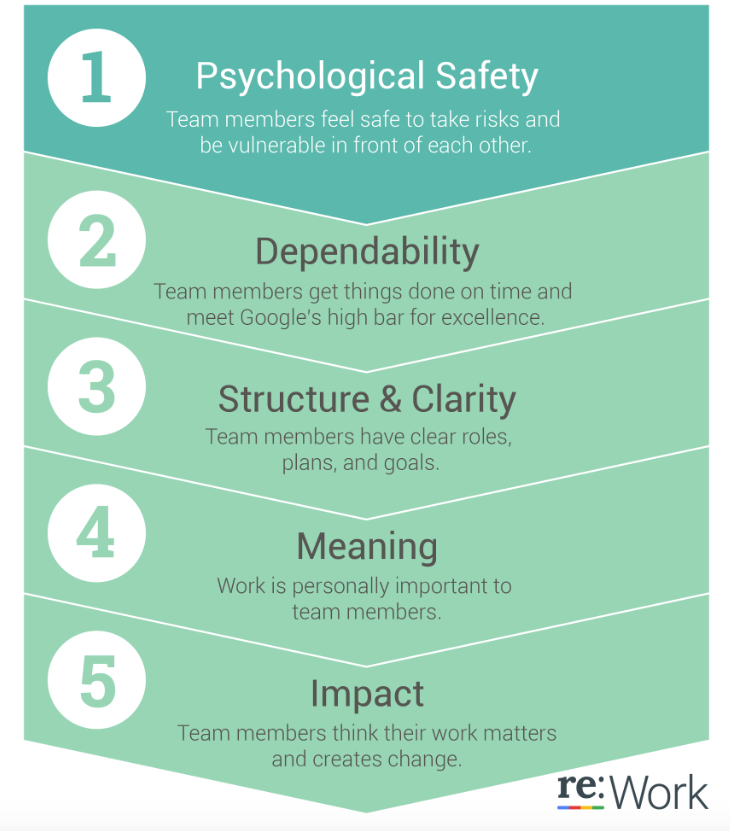
The team behind Project Aristotle had initially guessed that successful teams primarily required a structured hierarchy of intelligent minds. Instead, guided by Edmondson’s 1999 paper, they found that teams with a culture focused around value and respect were more successful. Essential to the success of the team was team members feeling safe to speak up, share ideas, questions, concerns and mistakes without fear of embarrassment or humiliation. These findings challenged conventional beliefs about team composition and management styles.
For Rozovsky, this also offered a personal lightbulb moment in making sense of her earlier experiences with the two different study groups at university. She could now better understand why one group was far more productive, happy and ultimately successful than the other; it was to do with their implicit group norms and the resultant degree of psychological safety experienced by those in the group.
Learning from Project Aristotle
To implement their findings, Google set out to create more psychologically safe environments by encouraging open communication, empathy and understanding. Their results had shown them that “even the extremely smart, high-powered employees at Google needed a psychologically safe work environment to contribute the talents they had to offer.” Rather than focusing on who the team was made up of, Google redirected their resources into making sure their 5 key factors were fostered in a team – the most important of these being psychological safety.
One tangible output of their research was Google’s creation of a ‘team effectiveness discussion guide’. The guide focused on the 5 key factors for a successful team, helping organisations to identify areas where they might want to improve and explaining how they could start. Dani Perez compiled and edited the whole re:Work book into a single pdf, available here.
If you want to dive even deeper into how to build psychological safety, here’s our top ten ways to foster psychological safety in the workplace.

Top Ten ways to Build Psychological Safety, psychsafety.com
What other team norms matter?
In addition to their core finding around the value of psychological safety, Project Aristotle demonstrated the importance of two more team norms that were foundational to team performance:
- Equality in conversational turn-taking: In high-performing teams, all members have an equal opportunity to speak.
- High “social sensitivity”: High performing teams are composed of individuals who are tuned into other team members’ emotions and needs. The ability to pick up on subtle social cues was fostered through greater time together (online or in-person).
What’s interesting about these is that they they both have the potential to positively influence psychological safety too, which perhaps explains why they matter for team performance. If all team members have more conversational opportunity to speak, then the first barrier to sharing your ideas – simply finding space to – is reduced. Similarly, team members with higher social sensitivity are much less likely to accidentally embarrass or ‘punish’ others for speaking up, because they are attuned to the impact of their actions.
And what doesn’t matter?
Interestingly, the researchers also discovered variables that were, to their surprise, not significantly connected with team effectiveness at Google. These included:
- Colocation of teammates (sitting together in the same office)
- Consensus-driven decision making (we don’t all need to agree on something in order to get it done)
- Extroversion of team members
- Individual performance of team members (indeed, some evidence shows that the presence of “rock stars” on a team can actually hinder overall performance)
- Workload size (though because workload is managed in Google, this may not be an effective finding)
- Seniority
- Team size (though due to the project methodology and team practices in the organisation, it may be possible that the range of team sizes in Google didn’t extend far enough to highlight the limiting effects of large teams)
- Tenure
Changes Inspired by Project Aristotle
Another notable example from the project involved a manager named Matt Sakaguchi. Sakaguchi had become interested in Project Aristotle due to challenges with team cohesion in his previous role. He wanted to take proactive steps to improve his new team by engaging with the project. Rozovsky gave Sakaguchi a survey to assess his team’s norms, and on carrying this out, Sakaguchi found that almost every team member was dissatisfied.
To address the issues, Sakaguchi organised an off-site meeting. As part of that meeting, he ended up sharing with his team that he had stage 4 cancer. This act of genuine vulnerability helped to model open and honest communication with the team, creating space for more psychological safety. From this more open place, the team began to discuss the survey results and they agreed to adopt new norms inspired by the type of communication that Matt had just introduced.
Once Project Aristotle was published in 2014, Google created an extremely useful web resource that described their findings and research, re:Work with Google. Google briefly had a glitch with this page, and we used to have to direct people to it via the Wayback machine, but it’s thankfully back up and running now.
Psychological Safety in the Spotlight
Despite this fascinating work and the impact it began to have straight away at Google, it still took a while for value of psychological safety to be known and understood across different domains, industries and workplaces. It was in fact a New York Times article about Project Aristotle that propelled Amy Edmondson’s research on Psychological Safety into the limelight, and her 2018 book ‘The Fearless Organisation’ has inspired transformations in organisations across the world. Project Aristotle helped provide and publicise the real-world relevance of the concept, encouraging people to see that it could now be applied to improve teams and performance in the business world, and was far more than something to only be studied academically.